Direct Answer
The UPVC guttering is a rainwater drainage system made from unplasticized polyvinyl chloride, a rigid plastic that withstands rust, UV, and corrosion. It’s specified under BS EN 12200-1:2016 for above-ground rainwater piping. Malaysian developers use UPVC gutters on landed homes, high-rises, and commercial projects because the gutter handles tropical rainfall and heat with far less maintenance than metal gutters.
You’re comparing gutter suppliers, and most of them often say the same three words: durable, weatherproof, low-maintenance. Unfortunately, none of that tells you whether the roof rain gutter survives Malaysia’s intense, unpredictable weather.
Let’s take the place where EverPlast was founded as an example. Peninsular Malaysia averages around 2,540mm of rain a year. Meanwhile, most of Sarawak gets 3,050mm, and Sabah ranges from 2,030mm to 3,560mm (Encyclopedia Britannica, drawing on METMalaysia records).
Thus, a rainwater system here needs to be stronger than the same rain gutter in a temperate market.
We don’t mean to scare you, but if you get the UPVC gutter specification wrong and you’re back on site in year 6, resealing joints. On the other hand, getting the gutter spec right allows the gutter system to survive the defects liability period without a single callback from your residents.
Throughout this guide, we’ll walk through what UPVC gutters are made of, how they work, the types of gutters, how long they last, and everything about installation, cleaning, and repair.
What is UPVC guttering made of, and how does it work?
Direct Answer
UPVC gutter is extruded from unplasticized polyvinyl chloride, a rigid PVC that contains no added plasticizers, and then formulated with UV stabilizers and impact modifiers so it withstands direct tropical sun without becoming fragile.
The missing plasticizers are the root cause. Plasticizers migrate from the polymer when heated, which is why flexible PVC softens and sags over a few seasons.
Surprisingly, UPVC keeps its shape. That dimensional stability is why BS EN 12200-1:2016 specifies PVC-U for above-ground rainwater systems.
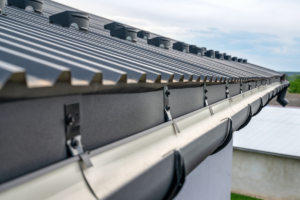
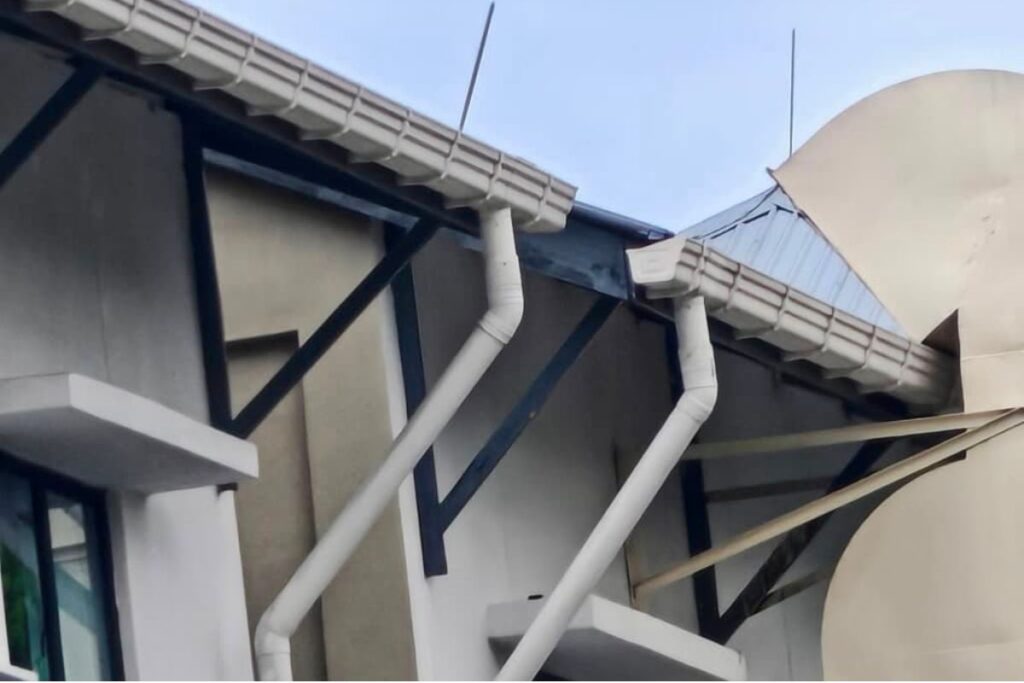
A gutter run catches water off the roofline and directs it to a downpipe. Every UPVC gutter system uses the same parts:
- Gutter run. The open channel along the roof edge.
- Fascia brackets. Fix the run to the fascia board, usually every 600mm on UPVC.
- Union joints. Connect and increase UPVC lengths into one continuous run, sealed with an EPDM rubber gasket.
- Stop ends. Cap the open ends so water doesn’t spill off the side.
- Outlets and hoppers. Collect water at the low point and feed it into the downpipe.
- Downpipe. Carries water to ground level, typically 75mm to 100mm across depending on roof area.
Here’s the good news. UPVC won’t rust or rot. That feature is what removed cast iron and mild steel from Malaysian residential and light commercial roofs over the past 20 years.
What types of UPVC gutters are available, and what sizes are available?
Direct Answer
UPVC gutters consist of three profiles: half-round, square-line (ogee) and deep-flow industrial. Nominal widths start from 100mm on landed homes to 200mm and above on high-rise and industrial roofs. The roof catchment area and peak rainfall intensity determine which profile you need.
The table presents each profile with its bracket spacing, downpipe sizing and typical catchment, so you can check a supplier’s quote against your roof area before you make your decision.
Profile | Nominal width | Approx. flow capacity | Bracket spacing | Downpipe pairing | Typical catchment / use |
|---|---|---|---|---|---|
Half-round | 100 – 125 mm | ~1.0 – 1.6 L/s | 600 mm | 65 – 75 mm | Landed terrace, semi-D, low-rise residential |
Square-line / ogee | 112 – 150 mm | ~1.6 – 2.4 L/s | 600 mm (500 mm at corners) | 75 – 90 mm | Modern residential, mixed-use, shoplots |
Deep-flow industrial | 150 – 200+ mm | ~2.4 – 4.5 L/s | 500 – 600 mm | 100 – 110 mm | High-rise, factories, warehouses, large commercial roofs |
Flow capacity is indicative at a 1:600 fall. Check against your project’s calculated peak flow before specifying. Bracket spacing follows BS EN 12200-1 practice for PVC-U systems.
How do you size a UPVC gutter for a Malaysian roof?
Size the UPVC gutter to the roof’s effective catchment area and the design rainfall intensity at the site.
The Department of Irrigation and Drainage’s Urban Stormwater Management Manual for Malaysia (MSMA, 2nd Edition, 2012) sets a minimum time of concentration of 5 minutes for roof drainage, and publishes station-specific intensity-duration-frequency constants for locations across the country. A roof in Kuching sizes differently from the same roof in Kuala Lumpur.
For a working reference, the EverPlast UPVC gutter system has a high water capacity of 20 liters per meter, with a deep-flow profile, sized 220mm wide and 120mm to 160mm deep.
For more information, see our full breakdown of EverPlast’s UPVC rain gutter R220 profiles, styles, and sizes.
Is UPVC guttering waterproof?
Direct Answer
UPVC guttering is waterproof. The material doesn’t absorb or leak water. Leaks start at the joints.
The rigid PVC channel carries water without trouble. Despite that, union joints are where PVC gutter systems fail.
An EPDM gasket seals two lengths together, but the gasket perishes, or the joint comes loose due to repeated thermal expansion in Malaysia’s intense heat.
BS EN 12200-1:2016 requires PVC-U rainwater systems to be leak-tight under test conditions, covering the components as supplied.
What happens on-site depends on whether the installer properly applied the gaskets and left the expansion gap.
On our own project inspections, gasket seating and missing expansion gaps account for most of the leak callbacks we attend.
Our guide on UPVC gutter waterproofing covers how to check and maintain those seals.
How long does UPVC guttering last in Malaysia's climate?
Direct Answer
UPVC guttering in Malaysia usually lasts up to 15 years. Aluminum survives 20 to 30 years. In Malaysia, UV exposure and roof surface temperatures above 60°C break down the polymer faster than in temperate markets.
Those lifespan figures of 15 years come from Malaysian roofing contractor Roofing Man’s 2026 material comparison, and they align with what specifiers report for tropical installations. The band is wide because three factors move it: UV-stabiliser quality, bracket spacing, and installation fall.
Signs your UPVC rain gutter system is near the end of its service life:
- Chalking or fading. A powdery white residue on the surface means the outer layer is breaking down.
- Cracking at brackets or joints. Stress points where thermal movement focuses.
- Sagging sections. Usually an under-bracketed install, so check the spacing before you blame the material.
- Persistent leaks at unions. Perished gaskets that won’t seal even after refitting.
Across around 100 Malaysian installations, we find correctly bracketed runs with UV-stabilised formulation last around 8 to 15 years. In contrast,under-bracketed runs fail years earlier.
UPVC vs metal guttering: which should you choose?
Direct Answer
UPVC gutter costs a third to a half as much as aluminum per meter and never needs repainting. Aluminum and stainless steel last two to three times longer when exposed to the Malaysian sun. Your Budget, building lifespan, and roofline access decide which gutter material to choose.
Material | Service life | Corrosion risk | Thermal movement | Maintenance burden | Best fit |
|---|---|---|---|---|---|
UPVC (PVC-U) | 8 – 15 yrs | None; won’t rust or rot | High; needs expansion gaps | Low: no repainting, periodic joint reseal | Cost-sensitive residential, fast programmes |
Aluminium | 20 – 30 yrs | Very low | Moderate | Low: minimal upkeep | Best all-round balance for Malaysian conditions |
Galvanised iron | 10 – 15 yrs | High once coating breaches | Low | Moderate: repaint to stop rust | Traditional builds, budget metal option |
Stainless steel | 30+ yrs | Very low | Low | Very low | Coastal sites, long-life commercial assets |
Cost and lifespan figures: Roofing Man Malaysia, 2026 gutter material comparison. Check current pricing against live quotations.
Overall, UPVC wins on installed cost and program speed. Metal wins on service life and load capacity.
Which gutter material suits your property project depends on how long your building will remain standing and how easy the roofline is to access after the handovers and once the site team has left.
Each material has its pros and cons. But if you’re looking for a long-lasting, low-cost roof rain gutter with only low-maintenance needed, the Everplast UPVC roof rain gutter will, for sure, be your perfect choice to protect your property against pouring rain.
Check out our article, ‘UPVC vs aluminium gutters‘ for a comparison against aluminum, cast iron, and steel covers wind, weight, and coastal humidity performance.
How do you install UPVC guttering?
Direct Answer
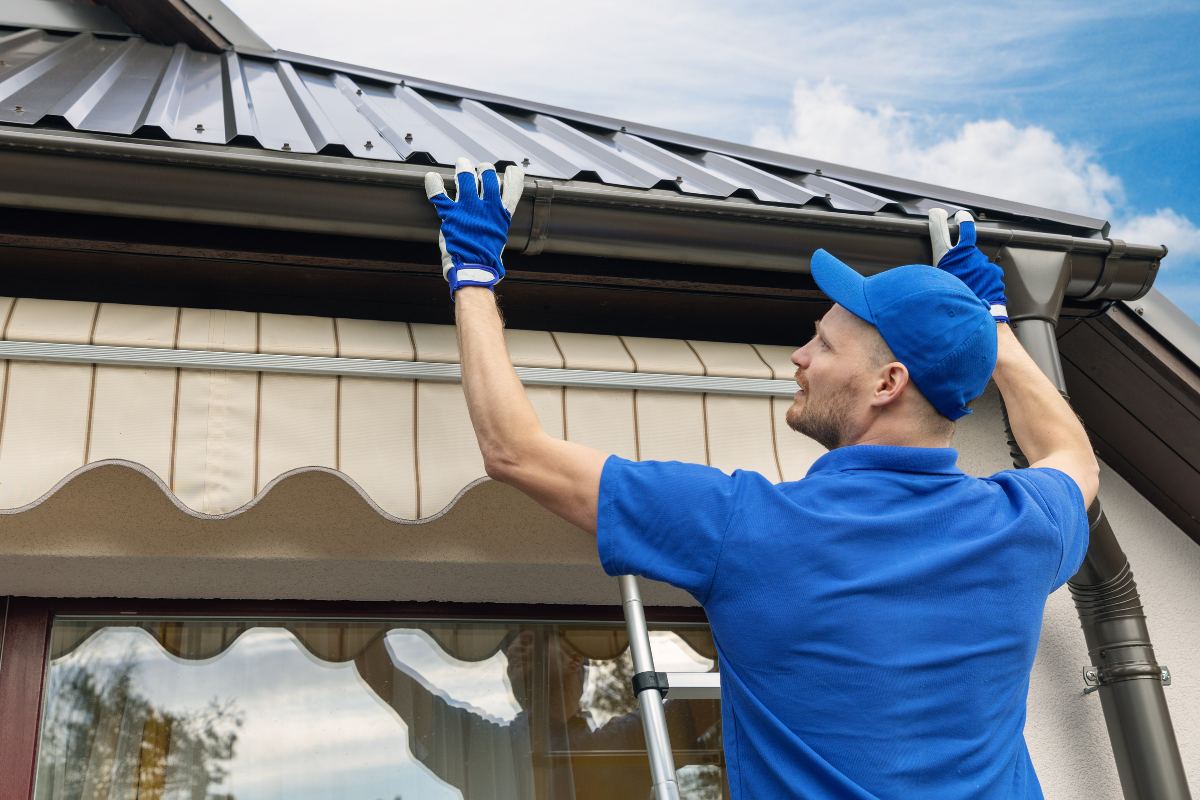
Installing UPVC guttering means setting a consistent fall to the outlet, fixing brackets every 600mm, and joining lengths with sealed unions that allow for thermal movement.
- Mark the fall. Roughly 1:600, about 3mm per meter, running to the outlet so water doesn’t pool.
- Fix the brackets. Every 600mm, tightening to 500mm near joints, corners and outlets.
- Fit outlets and stop ends. Position outlets at the low point of each run before you lay any gutter lengths.
- Join the lengths. Place each length into the union’s EPDM gasket up to the manufacturer’s insertion mark, and leave the expansion gap. Skipping the gap is what causes joints to crack under thermal cycling.
- Connect the downpipe. Match diameter to roof catchment: 75mm for standard landed homes, 100mm or larger for commercial roofs.
- Flow-test before sign-off. Run water through the whole system and observe pooling or weeping at any joint.
Should your team install it, or hire a specialist?
An experienced general contractor can easily handle single-story houses. High-rise and large commercial projects involve scaffolding, catchment calculations and sequencing with the roofing crew. Consider an installer who does UPVC gutter systems for a living, so the fall is right first time, and the manufacturer’s warranty holds.
EverPlast roof gutters come with a 7-year warranty, including professional installation, so you don’t have to worry about costly gutter replacements. Yet, we are confident in our gutter’s quality, and the rainwater system won’t break all of a sudden.
When choosing a gutter installer, check their CIDB grade and contract value. G5 to G7 firms manage the larger property developer packages. Our step-by-step installation guide covers how to join plastic guttering without leaks.
How do you clean and maintain UPVC guttering?
Direct Answer
Clean UPVC guttering twice a year, before and after the monsoon. Blockages cause overflow, which loads brackets and joints well beyond their design conditions.
Malaysia’s monsoons are usually predictable. The northeast monsoon occurs roughly from November to March and brings the heaviest rain to the east coast and Sarawak, per METMalaysia. So schedule around it.
- Clear debris by hand or scoop. Leaves and sediment congest fastest under overhanging trees.
- Flush from the highest point. Confirms water reaches the outlet without pooling anywhere along the run.
- Inspect joints and brackets while the access is up. Catching one loose bracket costs a fraction of what re-supporting a sagged run later costs.
- Time it around the monsoon. Clean before the wet season and again after, when debris load becomes almost full.
For managed developments, our team recommends a documented twice-yearly inspection tied to the handover maintenance schedule. Contact Us if you need assistance with the maintenance service.
Our guide on how to clean UPVC guttering covers frequency and seasonal timing in full.
How much does UPVC gutter repair and replacement cost?
Direct Answer
UPVC gutter material often costs RM15 to RM30 per metre, but it varies depending on your property project size. A leaking joint costs a fraction of a section replacement, because most joint failures come down to reinstalling a gasket or swapping one union.
Note that the information presented in the table is only used as a forecast. The downtime and the relative cost can vary based on different project applications.
Issue | Likely cause | Typical fix | Downtime | Relative cost |
|---|---|---|---|---|
Leaking union joint | Perished EPDM gasket, or no expansion gap | Reseal or replace the union | Under 1 hour | Low |
Cracked short section | Thermal stress at a fixed point | Cut out and replace the affected length | 1 – 2 hours | Low – moderate |
Sagging run | Bracket spacing over 600mm | Add brackets, re-set the fall | Half day | Moderate |
Chalking across the run | UV degradation at end of service life | Full system replacement | 1 – 2 days | High |
Downtime assumes ground-level or single-storey access. High-rise work costs more on access alone.
We recommend inspecting and troubleshooting the problems early, and the cost to fix the issues stays low. Leaving a roof gutter system uninspected for years may cost you an arm and a leg.
Our UPVC gutter repair and replacement cost guide covers pricing in detail, including how to fix a leaking gutter joint.
What colours does UPVC guttering come in?
Direct Answer
UPVC guttering comes in white and grey as standard, with custom colours available from some suppliers on larger developments. Colour goes into the material during extrusion.
Through-coloring is why UPVC never needs repainting to remain weatherproof. Unlike galvanized iron, UPVC guttering has no coating to breach.
Here’s an interesting fact: darker surfaces absorb more heat and move more under thermal cycling, so expansion gaps are more important for black and dark grey designs than for white. Worth flagging to the architect if the facade scheme is going dark.
You can always paint UPVC guttering to match a facade’s color outside the standard range, using a primer made for plastic substrates.
Confirm EverPlast’s warranty position on painted systems before recommending guttering to your clients.
Our gutters come in 2 default colors: white and grey.
How do you examine a UPVC gutter supplier in Malaysia?
Direct Answer
Check three requirements before you shortlist: certification against a recognized standard, CIDB registration and grade, and written stock and delivery capability for your site and timeline.
What to verify | What good looks like | Why it matters |
|---|---|---|
Product standard | Compliance with BS EN 12200-1:2016 (PVC-U rainwater systems) or MS 1063 for Malaysian uPVC pipe | Gives you a testable specification you can hold them to |
SIRIM certification | Valid, current certificate covering the exact product range quoted | Many developers and government tenders make the SIRIM cert a condition of award |
CIDB registration and grade | Grade matched to contract value; G5 to G7 for larger developer packages | Ungraded or under-graded suppliers create contractual exposure |
Stock and lead time | Written lead times, including to East Malaysia | Sarawak and Sabah deliveries are where schedules are hard to meet |
Warranty terms | Written scope, duration and claim procedure | Decides whether a failure at year 6 is your cost or theirs |
Project references | Named, contactable projects of comparable scale and roof type | The strongest single predictor of post-handover support |
Verification checklist for Malaysian developer and contractor procurement. Standards references: BSI, Department of Standards Malaysia, CIDB.
Ask the supplier to show any relevant certificates. A trustworthy supplier, such as EverPlast Malaysia, who produces current documentation within a working day is usually the one still answering to your queries three years after handover.
Choosing the right UPVC gutter system for your project
If you are asking ‘what is UPVC guttering’, the answer is a rainwater drainage system made from rigid unplasticized PVC. UPVC guttering won’t rust, installs faster than metal, and costs a third to a half as much as aluminum per meter.
Whether the UPVC gutter suits your property project depends on profile, installation quality and supplier.
Five checks before you award:
- Size the system to actual roof catchment using MSMA intensity data for the site.
- Specify against BS EN 607:2023, the current eaves gutter standard, with MS 1063 covering the downpipe side.
- Hold the installer to 600mm bracket spacing and a 1:600 fall.
- Confirm CIDB grade and current SIRIM certification.
- Get warranty scope and claim procedure in writing.
Price per meter is the easiest number to compare.
Are you looking for a reliable, durable roof rain gutter for your property project? You’ve come to the right place that helps. Reach out to our team to request a quote for our UPVC rain gutter today.